
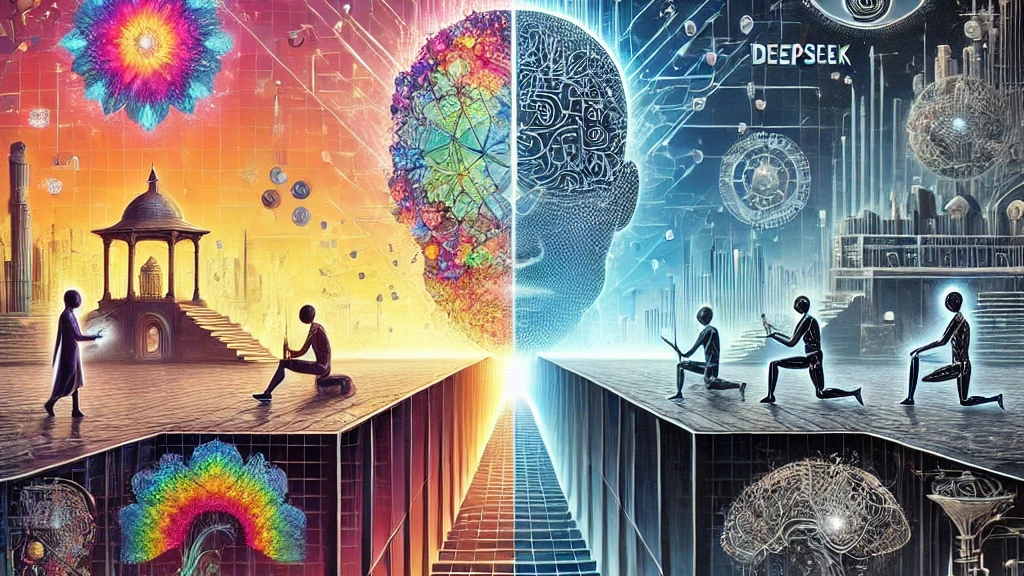
Cultural Roots in AI: How DeepSeek and ChatGPT Reflect Different Worldviews
Written by Siew Meng Loh
I will now attempt to bridge the widening chasm of misgivings between David and Goliath, sorry, I mean ChatGPT and DeepSeek.
In the names themselves, and people that matter pour millenniums of hours to craft them, we already see the starting 1 degree of deviation between warmth and precision, and between emotional resonance and pragmatic clarity.
ChatGPT embodies a more human-like, expressive approach, often engaging in storytelling, humour, and empathetic dialogue. It mirrors a culture that values emotional connection, debate, and the art of conversation.
DeepSeek, on the other hand, feels more reserved and methodical, delivering information with structured precision and less emphasis on emotional engagement and values efficiency, hierarchy, and the authority of knowledge.
In other words, Chat gushes while Deep, well, seeks. In a sense, Deep aligns more in principle with Gemini, which stemming from its roots as the de facto search engine, is obsessive over defining facts from the chaft of internet chatter.
This creates a fundamental divide in how the models feel to users—one invites exploration and interaction, while the other prioritizes accuracy and directness. “Would you like to expand on this?” to “This is a strong development that can inform other work.”
Since AI presently utilize Large Language Models (LLM) as the basis for reasoning, it follows that the variations in LLMs will introduce intriguing contrasts that extend beyond just technical architecture. Their differences reflect deeper cultural influences—shaped by linguistic foundations, philosophical traditions, and societal values.
Note: This analysis is based on information available up until 2024. For the latest updates on AI models and their development, checking current sources is recommended.
Western Logic vs. Eastern Pragmatism
At a fundamental level, Chat and Deep appear to differ in their epistemological approaches to knowledge and communication, mirroring distinctions in Western and Eastern thought traditions, as much as the US and China can be described as such, respectively.
Chat’s Open-Ended Exploration
Rooted in Western traditions of debate, Socratic questioning, and individual expression, Chat’s responses often prioritize creativity, engagement, and flexibility. It is designed to encourage discussion, provide multiple perspectives, and facilitate open-ended exploration of topics, aligning with cultures that value free discourse and personal interpretation.
Deep’s Structured and Context-Aware Approach
In contrast, Deep reflects a more pragmatic and hierarchical approach to communication, influenced by Confucian principles and collectivist values. Rather, it is influenced by their programmers who are influenced by such values. It tends to present information in a structured and fact-oriented manner, emphasizing clarity, authority, and efficiency. Rather than encouraging debate, it often aligns with an approach that seeks to deliver precise and definitive answers.
In a way, using Chat is like riding a horse which is more fun but you have to learn to steer the sometimes unwieldy beast.
Using Deep, on the other hand, is like trying to keep up with your accountant on your accounts – you know it gets done reliably, but you won’t stay for coffee.
Presentation of Results: Emotion vs. Accuracy
Cultural roots not only shape how these AI models process information but also how they present it.
ChatGPT’s Conversational and Emotional Emphasis
Chat crafts responses with a conversational tone. It integrates humour, empathy, and narrative-driven explanations—often prioritizing emotional resonance and inviting connection.
Deep’s Accuracy and Directness
Reflecting a preference for efficiency and respect for expertise, and may I dare say, a penchant for expediency when it comes to work, Deep’s responses are more structured and direct. Less in emotions or engaging in speculative discussions, there is accuracy and clarity.
One is functional while the other is more embellished and exploratory. Since we don’t pay per word for use (yet), the practical aspects are less important except for their appeal to the more conscientious among us.
Here, I must emphasize that practical does not mean utilitarian because Deep does attempt to lighten things up with personable utterances. However, if you are looking for an adventure every time you start something, and needing to be stricter than a headmaster on instructions when you are pressed for an answer, Chat is your buddy in crime.
The Bigger Question: Should AI Adapt to Cultural Expectations?
These differences raise important questions about the future of AI communication:
- Should AI be tailored to different cultural preferences, or is there an ideal universal model?
We are dealing with institutional knowledge, after all, with all its nuances and contextual gift wrapping.
Eastern culture is popularly described as high context (the flick of the corner of the eyebrow flows with the words) and the west is decidedly less contextual.
The Global AI Debate
Thomas Friedman, a journalist for The New York Times, argued in his 2005 book that technological innovation has connected the world. He saw this as a “flattening” of the world, as the global playing field is being levelled to include more input and contributions from nations outside the (industrialized) West.
In contrast, Samuel Huntington’s Clash of Civilizations and the Remaking of World Order (an expansion of a 1993 Foreign Affairs article) suggests that deep-seated cultural and ideological divides will continue to shape global interactions.
So, are we beginning to see a clash across a flat earth including how AI develops and is received?
Here, I will borrow a Chinese saying in an attempt to bridge the chasm:
“If you don’t fight, you don’t become more familiar.”
Since we are on the topic of language, we could add at the end:
“…you become weaker.”
What a difference a few words make!
The differences between Chat and Deep may, in some ways, reflect this ongoing tension between a world growing more interconnected and one still deeply defined by cultural distinctions.
I would say this, some things in life are meant to be above cultural differences, like the Olympics, ice-creams and other foods, bell bottoms, and the list goes on.
I hope AI makes the list.
As AI continues to evolve, understanding these cultural influences can help shape models that are not just powerful but also culturally adaptive—ensuring that AI aligns with the diverse ways humans process, use and value information.